
Read our Algobi review, an in-depth look at a company that promises users “A Friendly Hand in Every Trade.” According to the official information on its website, this broker offers traders everything they need: a wide selection of CFDs, competitive trading costs, and customer-focused multilingual support. In reality, however, the situation is quite different. The platform was created by scammers who accept clients’ deposits with the sole intention of stealing their money. There is more than enough evidence to support this claim, and you’ll find it below.
How We Reviewed Algobi
Our review of Algobi is based on a combination of publicly available information, official regulatory records, technical analysis, and hands-on testing of the broker’s services. Rather than relying solely on the claims published on the company’s website, we independently verified the key aspects that determine a broker’s reliability and transparency.
During our investigation, we examined:
- The company’s registration details and regulatory status.
- Domain registration data and website history.
- The broker’s legal documentation, including the Client Agreement and trading specifications.
- Account opening and verification procedures.
- Deposit and payment methods available to clients.
- Trading conditions, including leverage, spreads, swaps, and account types.
- User feedback published on independent platforms such as Trustpilot and WikiFX.
We also compared Algobi’s practices with the standards applied by reputable financial regulators and assessed whether the broker provides an adequate level of investor protection. Every conclusion in this review is supported by verifiable facts rather than marketing claims or promotional materials.
For details of our sources, assessment principles and Expert Rating, see our editorial standards and review methodology.
What Algobi Says About Itself
A single glance at the broker’s official website is not enough to draw conclusions about the legality of its operations, the transparency of its trading and non-trading conditions, its honesty, etc. To make well-founded statements about these matters, it is necessary to conduct a comprehensive analysis, including information from independent sources, as well as data about the platform and its offerings. It is precisely on the basis of such an analysis that our algobi.com review was created. In the website footer, the Client Agreement, and the About Us page, the broker states that it operates under the management of DXA SEYCHELLES LIMITED, a company registered in Seychelles that holds a Securities Dealer license issued by the local financial regulator, the Financial Services Authority (FSA).
The company’s history is also of particular interest to us, or at least the date it began operating online. Unfortunately, the owners of Algobi chose not to disclose this information, so we had to establish the facts using materials from open sources.
algobi.com Analysis: Domain, Site Age, and Technical Footprint
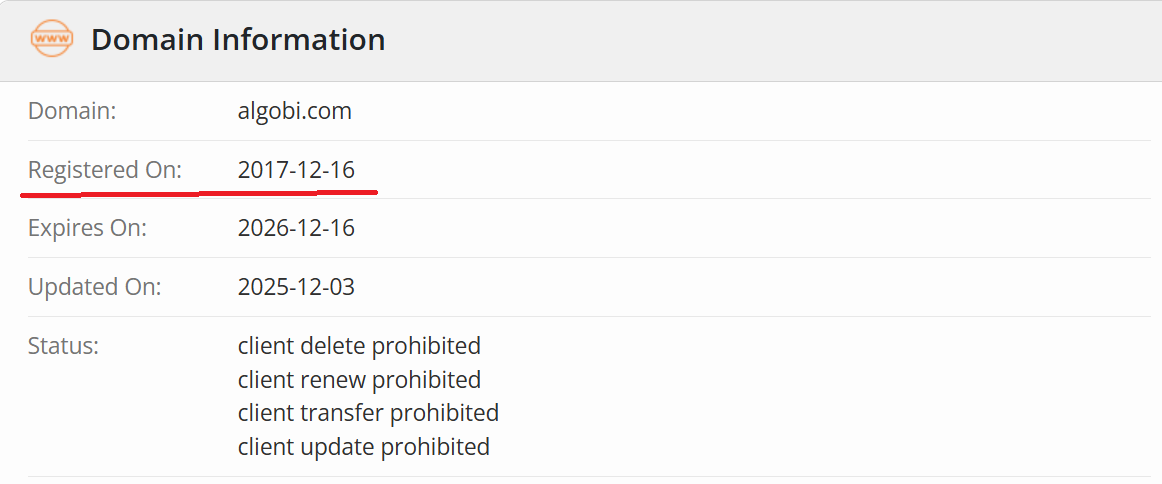
The WHOIS service data shows that the algobi.com domain is quite old, having been registered in December 2017. However, we cannot believe that the broker has actually been operating for 8.5 years — it is far too little known online. Our doubts are confirmed by snapshots from the Web Archive: the first complete snapshot of the homepage appeared only on 12 August 2025. Therefore, we can conclude that the website was launched only in early summer 2025, which means that today the platform is only about a year old.
Getting acquainted with the broker’s official website was deeply disappointing. It looks very simplistic (we deliberately chose not to use the word “poor” when referring to a Forex/CFD broker) and completely unprofessional. For example, the web designers seem to have problems with page scaling, while the content managers struggle to provide important information and to find and publish materials useful for traders. Just imagine what awaits users in the personal account area and the trading terminal.
Have you imagined it? Unfortunately, not everyone will be able to compare their expectations with reality. We ourselves were taken aback when, after filling out the registration form, we received a message apologizing and informing us that Algobi does not accept clients from our country. We, of course, resolved this issue, but we would still like to see the full list of Restricted Areas. After all, our country is not included in the list published in the website footer.
Overall, the procedure turned out to be long and tedious. It requires filling out forms on several screens, where users must provide all their personal information, including their TIN. Why the broker needs all this data remains unclear to us: it simply cannot act as a tax agent for all users, and no regulator requires such detailed information as part of the KYC process. There is also another, equally important question: how does the company intend to use the information it collects?
However, the process does not end with personal data. After entering it, users are presented with a questionnaire requesting information about their income level, sources of trading funds, market experience, etc. This is another rather questionable step: regulators do not require this information or the classification of clients into retail and professional categories. Moreover, the broker itself does not perform such categorization. So why collect this data, and how will it be used in the future?
After that, the process becomes more straightforward: the system offers users the opportunity to complete verification and deposit funds. However, the latter step can be skipped and completed later through the personal account.
On its website, Algobi assures us that deposits can be made using about a dozen payment methods — from bank transfers to electronic payment systems. However, an actual attempt to fund an account paints a much less attractive picture: many of these options simply do not work (perhaps their availability depends on the country from which the user is making the transfer). In reality, there are only two methods that are consistently available to all clients: deposits via credit/debit cards and cryptocurrency wallets.
There is also a problem with the latter. All brokers are required to comply with AML policy, and the company claims that it operates in accordance with these rules. However, cryptocurrency transactions are anonymous for both the sender and the recipient, while the company does not hold VASP/DASP (Virtual/Digital Assets Service Provider) authorization. This raises the question of whether its AML compliance is anything more than words.
Thus, even at this stage, Algobi raises numerous questions: about the collection and use of unnecessary information about traders, the transparency of incoming financial transactions, compliance with AML policy, etc. We believe that a broker operating honestly cannot afford such practices. On the other hand, for a platform whose sole purpose is to collect traders’ deposits, such an approach is quite understandable.
Algobi Trading Conditions: Account Tiers, Deposits, and Disclosure Gaps
The broker managed to surprise us with the disclosure of its trading conditions. Most offshore platforms avoid publishing such detailed information about trading parameters. In this respect, the project undoubtedly stands out in a positive way.
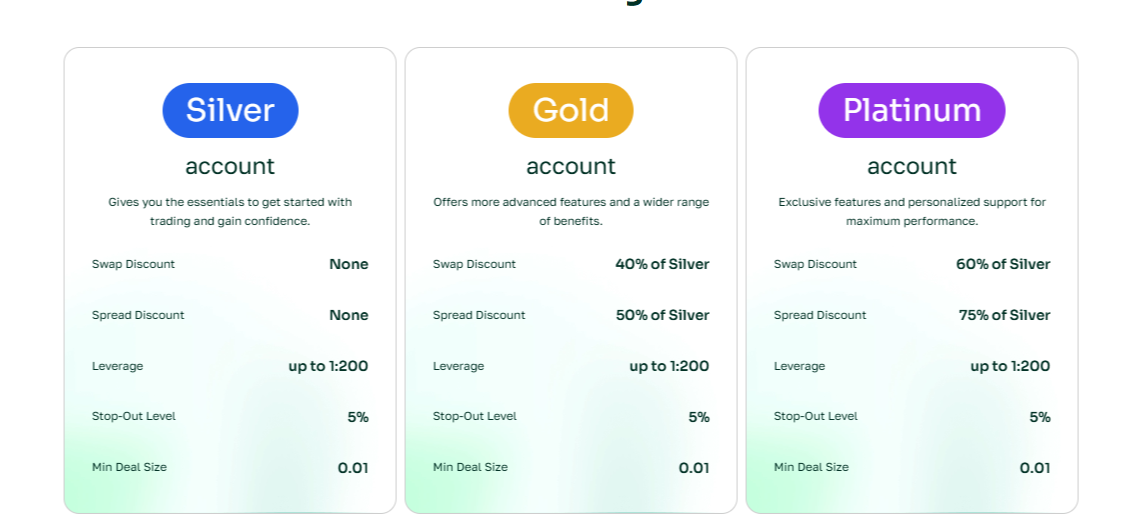
A trader can obtain the initial information on the page describing the account types. Algobi offers only three account types: Silver, Gold, and Platinum. They also have quite a lot in common:
- Leverage — up to 1:200.
- Minimum trade size — 0.01 lot.
- Stop Out — 5%.
Let us say from the outset: the 1:200 leverage offered by the broker represents a level of risk for traders that goes beyond acceptable limits. For example, in Europe, Australia, and the United Kingdom, the maximum leverage available to retail investors is 1:30. Higher leverage is available only to those who qualify as professional clients. However, even under these restrictions, more than 80% of traders lose their deposits.
Another parameter worth paying attention to is the extremely low Stop Out level of just 5%. In this case, if a trader has used their entire deposit as margin, after the broker forcibly closes the positions, only 5% of the original deposit will remain. This will most likely be insufficient to open new positions, making another deposit necessary. The platform owners’ approach is understandable — they are interested in attracting additional client funds.
In fact, the only differences between these account types are the spreads and swaps. On the Gold account, they are 50% and 40% lower than on the Silver account, respectively, while on the Platinum account they are 75% and 60% lower. Such reductions in trading costs could be quite significant; all that remains is to find out the base values from which these discounts are calculated.
Algobi has published the details of its trading conditions in the Contract Specifications document on the Company-Legal page. There, users can find:
- Margin requirements (which can easily be converted into leverage).
- Minimum and maximum contract sizes in standard lots.
- Standard lot size.
- Minimum price increment.
- Swaps for long and short positions for the Silver account.
- Trading schedule.
There are quite a lot of details, and the trading conditions are disclosed almost completely. Only a couple of remarks remain:
- The margin requirements are provided separately for retail traders (3.33% margin, 1:30 leverage) and professional traders (0.5% margin, 1:200 leverage). Then why does the company offer all clients, without exception, trading conditions intended for professionals? Are the owners of Algobi doing this deliberately so that beginners unfamiliar with risk management principles and their application will quickly lose their deposits?
- Why does the specification not include the base spread values? Or are they, even after discounts, not as competitive as the company’s representatives claim?
Be that as it may, even all the details provided by the broker are not enough to make a balanced assessment of its offering. In fact, judging by its approach to organizing trading, we can state without hesitation: everything at Algobi is designed to ensure that clients part with their money as quickly as possible.
Regulatory Footprint and Legal Transparency
Naturally, we verified this information in the relevant official registries.
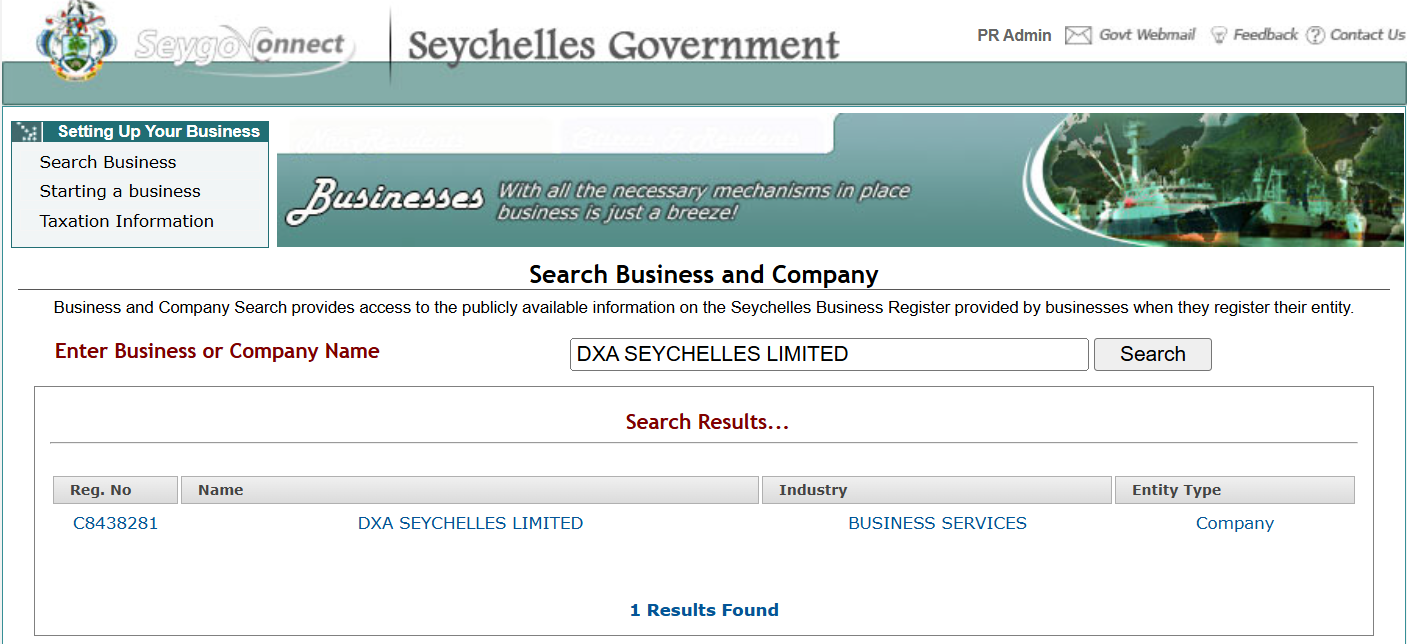
As we can see, the business registry confirms the existence of record No. C8438281 for DXA SEYCHELLES LIMITED. The information we obtained matches the details provided on the platform’s website. We verified the regulatory and licensing information in the FSA of Seychelles register.
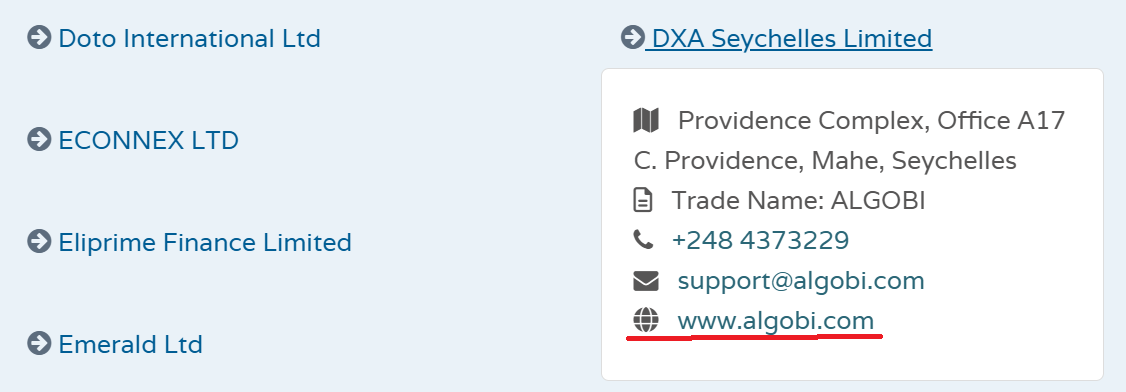
The search results show that the company has indeed obtained a Securities Dealer license. In addition, the record states that it operates through the website algobi.com. In fact, we received full confirmation that the broker provides services legally and operates in accordance with the laws of Seychelles. However, this does not answer the question of whether it is trustworthy.
The problem is that this country is one of the best-known offshore jurisdictions. Although the licenses issued by the FSA of Seychelles are officially recognized, they are not considered among the most reputable. Rather, they are generally classified as Tier 2 under the unofficial classification system. What does this mean?
- A broker that has obtained this license has officially registered in the country, and its activities are indeed subject to the supervision and regulation of the authorized government body.
- The level of client protection is not the same as that provided by firms regulated by Tier 1 authorities (European, British, or Australian regulators).
Indeed:
- The capital requirements that ensure the company’s ability to make payments to traders are significantly lower. To obtain an FSA license, according to the 2024 amendments, a company only needs capital equivalent to $100,000. By comparison, the equivalent requirement under the FCA is approximately $730,000, while the Australian ASIC has established a minimum threshold of AUD 1,000,000. Since this capital serves as the safety cushion in the event of bankruptcy or the broker’s inability to meet its financial obligations, it is clear that if problems arise, clients cannot expect to receive full compensation.
- The country has no Investor Compensation Scheme, either public or private. Accordingly, clients of the company have no access to compensation payments from this source.
- The regulator does not require client funds to be held in segregated accounts that are inaccessible to the company even for operational expenses.
- There are also no limits or restrictions on trading conditions, such as the maximum leverage available.
As a result, Seychelles licenses are generally obtained by brokers that have no chance of passing the strict oversight of top-tier regulators. Among them are many fraudulent projects that become “regulated platforms,” use this status to attract a large number of clients, and then steal their funds.
Algobi Reviews: What Can Be Seen on Online Platforms
Our assumptions about the project’s age were confirmed on Trustpilot. The first algobi.com review was published there on 11 August 2025. We are not inclined to believe that users waited 10–12 months before expressing their opinion about this platform.
Moreover, that opinion looks rather unappealing: 82% of the 201 reviews are strongly negative. However, the project’s owners clearly attempted to improve the situation by ordering positive publications about the broker. Unfortunately for them, the Trustpilot administration detected this activity, removed the fake posts, and stopped calculating the company’s rating. It warns all visitors to the page about this.
The users of Trustpilot are supported by their counterparts on WikiFX. There are only 4 reviews here (all negative), but each of them is illustrated with several screenshots of account balances and correspondence with the company’s support team. The platform’s rating on this portal also leaves much to be desired — 3.8 out of 10. The main issue determining the high level of risk is regulation with a low level of client protection. We discussed this above.
algobi.com Withdrawals and Exit Process
We have already discussed the lack of transparency in trading operations when reviewing the new client registration process and deposit funding. There is nothing more to add — the withdrawal process is no different from deposits.
However, we should still say a few words. The main complaint from both former and current clients in their reviews is the delay in processing withdrawal requests and the refusal to make payouts on far-fetched grounds, or often without providing any reason at all. Considering that the number of negative comments is many times greater than the positive ones, we can say that Algobi is extremely reluctant to part with clients’ money (we even suspect that it never does). Given the number of issues we found with this broker, we could hardly have expected anything else.
Pros and Cons of Algobi
-
Company registration and an FSA Seychelles licence are confirmed by official registry records.
-
The website advertises a relatively low minimum deposit of $250.
-
The company operates under an offshore licence, which offers a lower level of investor protection than regulation in major EU/EEA jurisdictions.
-
Leverage of up to 1:200 exposes retail clients to substantial risk, while the lack of disclosed spread information makes trading costs difficult to assess.
-
The broker collects personal data whose necessity is not clearly explained, and the available documentation provides limited clarity on how this information may be used.
-
There are indications that the project sought paid online reviews; after apparently inauthentic positive comments were removed, the remaining review profile was predominantly negative.
Editorial Conclusion
Thus, our Algobi review leads us to conclude that there is a high probability that we are dealing with a fraudulent broker. It relies on an offshore FSA of Seychelles license, which does not provide the necessary level of protection for clients’ rights and interests. As it turned out, even the trading conditions published by the company are insufficient to fully evaluate the platform’s offering, while the leverage creates a high level of trading risk. Add to this the negative reviews and the removal of fake positive comments, and the overall picture of the project becomes highly unattractive.


I am convinced that Algobi is just another scam. When they called me and started telling me how easy it was to trade and make a lot of money, I believed them at first. I opened an account, deposited $1,000, and later added more funds. But now they won’t let me withdraw my money. First, they ask me to pay a tax, then they tell me to wait for the cryptocurrency conversion, then they demand additional commission payments, and so on. This has been going on for the third week already, and it seems that I won’t get any of my money back from this scam.
Under no circumstances should you listen to these scammers from Algobi. They only talk about favorable cooperation terms, but in reality they care only about taking your money. Once you start trading and find yourself unable to make a profit or withdraw the remaining balance of your deposit, you will understand exactly what I mean.