
The Trusted Solutions For Asset Recovery analysis shows that the service promises fund recovery after online fraud, but does not disclose its legal entity, registration number, license, payment model, contract, or real case results. The tsfar.org domain appears young and privacy-protected, the Terms do not guarantee financial compensation, and there are few independent reviews. For this reason, we assess the service as high-risk and insufficiently transparent for sharing documents, payment data, and information about lost assets.
How We Reviewed Trusted Solutions
When reviewing Trusted Solutions For Asset Recovery, we treated the project specifically as a funds recovery service, not as a broker or an investment platform. As part of the analysis, we compared information from the official website, technical domain data, the Terms and Conditions and Privacy Policy, open business registers, regulatory warning lists, Trustpilot, Scamadviser, and signs of templated content.
This approach allows us to assess not trading conditions, but the transparency of the fund recovery service: who actually provides assistance, on what terms, whether there is a contract, how fees are disclosed, and how safe it is for a client to share personal and financial data.
For clients of recovery services, this is especially important. A person may already have lost money to a broker, crypto platform, investment scheme, phishing campaign, or another form of online fraud. Therefore, any promise of fund recovery should be checked through the legal entity, contract, workflow, fees, privacy policy, and real reputation.
What Trusted Solutions For Asset Recovery Claims About Fund Recovery
On its website, the service describes itself as a project that helps victims of online fraud and cyber threats. The listed service areas include Fraud Recovery Assistance, Cybersecurity Consulting, Financial Scam Investigation, Cyber Threat Detection, Identity Theft Protection, and Data Breach Response. The FAQ says the company helps with investment schemes, romance scams, phishing attacks, cryptocurrency theft, and other types of cyber fraud, and that it works globally.

The marketing section is built around promises to “recover your lost assets,” trace funds, identify offenders, and help restore justice. For a user, this sounds like an active money recovery service. However, the legal terms are much more cautious: the Terms and Conditions state that financial recovery is not guaranteed, and the service’s liability for losses and the consequences of recovery attempts is limited.
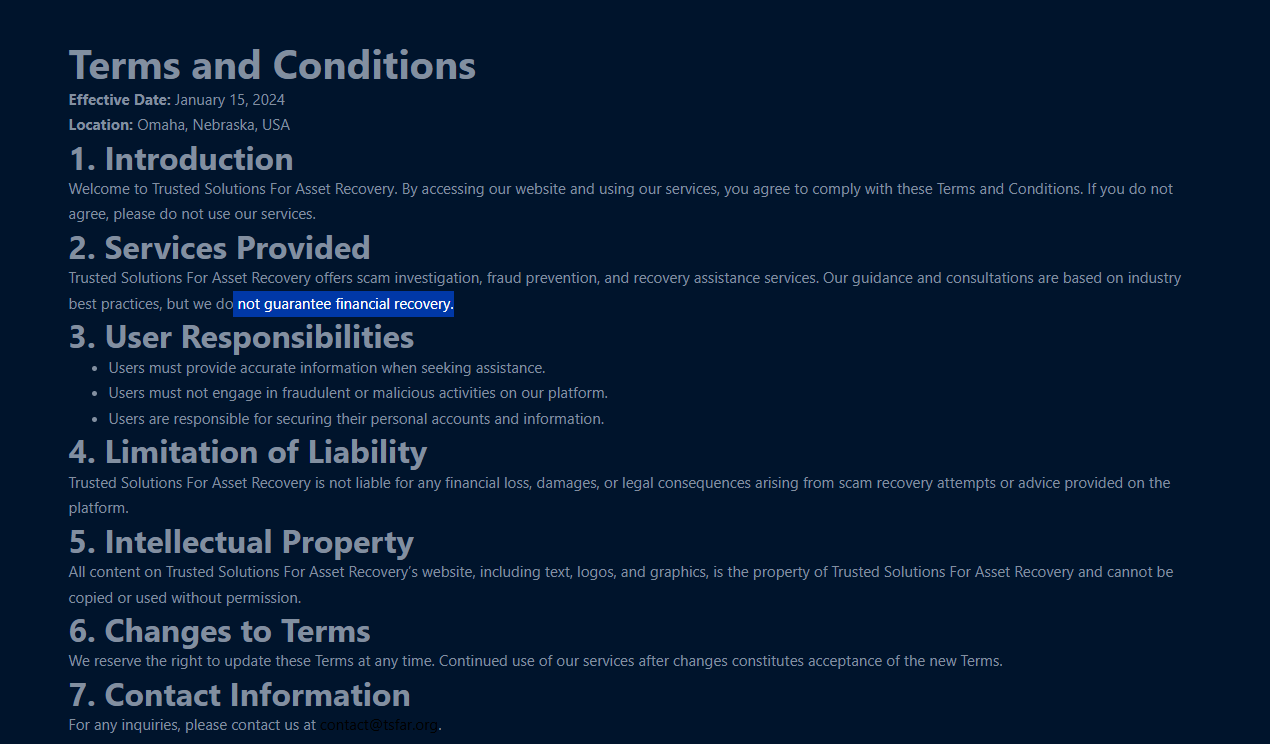
This is the key discrepancy. A legitimate chargeback consultancy cannot promise a result in advance, because the outcome depends on the payment type, bank, transaction timeframe, evidence, Visa/Mastercard rules, jurisdiction, and the behavior of the recipient of funds. The absence of a guarantee is not a violation in itself. The problem is that the website sells a broad promise of recovery but does not disclose the procedure a client could use to assess whether the result is realistic.
On the public pages, we did not find a clear price list, fee amount, success fee terms, information about possible upfront payments, a separate contract, refund policy, service timelines, cancellation rules, or documented case results.
A separate bank card chargeback procedure is also not disclosed. In the reviewed materials, we did not find a verifiable description of interaction with banks, Visa, Mastercard, financial ombudsmen, or law enforcement agencies. For a service that works with fund recovery, this lowers the predictability of the service.
Tsfar.org Analysis: Domain Check via ICANN Lookup
For the domain check, we used ICANN Lookup — the official ICANN service that allows users to view basic registration details: the domain creation date, registrar, registration expiry date, updates, and some technical data.
According to the technical snapshot used in the analytical materials, the tsfar.org domain was registered on September 18, 2025. The registrar is Dynadot Inc, the update date is March 3, 2026, and the renewal term runs until September 18, 2026. The owner details are hidden, the SSL certificate is a Let’s Encrypt Domain Validated certificate, the server is 20i Limited, the IP address is 185.151.30.132, and the nameservers are ns1.beak.host, ns2.beak.host, ns3.beak.host, and ns4.beak.host.
| Parameter | What the check shows | Why it matters |
| Registration date | 18.09.2025 | The domain looks recent for a service claiming experience |
| Registrar | Dynadot Inc | A neutral technical fact |
| Owner | hidden | It is harder to understand who stands behind the service |
| SSL | Let’s Encrypt DV | A basic certificate that does not confirm a legal entity |
| Registration term | until 18.09.2026 | A short registration horizon for a trust-based service |

A young domain does not prove misconduct by itself. But here there is an inconsistency: the website contains claims about “years of experience,” the policies have an effective date of January 15, 2024, and some materials are dated March 2025 — earlier than the registration date of the current domain. This may be explained by a site migration from an older domain or by templated content. However, the public materials do not disclose evidence of the brand’s previous history.
Legal Status and Service Transparency
The legal side remains one of the main weak points of the review. The Contact page lists the address 3281 E. Guasti Road, 7th Floor, 91761 Ontario, CA, the phone number +1 365 360 0247, and the email address contact@tsfar.org. The address refers to the city of Ontario in the state of California, United States. At the same time, on the public pages we did not find a registration number, the full legal name of the company, a license, a supervisory authority, or a management structure.

There is also noticeable geographic ambiguity. The contact address points to Ontario, California, the legal documents and Privacy Policy use Omaha, Nebraska, and the 365 phone code belongs to Southern Ontario in Canada. Individually, these elements may be explained by remote work, a virtual office, or an international structure. Taken together, however, they make a basic check more difficult: which exact company the client enters into a relationship with and in which jurisdiction it actually operates.
According to the analysis, the address in Ontario, California, matches Regus Lakeshore Center, where offices, coworking spaces, and virtual offices are offered. This does not mean the address is false. But by itself, this contact address does not confirm the presence of a full operational office, staff, or regulated presence for this specific company.
For a funds recovery service, this is critical. A client may share correspondence with brokers, payment data, bank documents, crypto wallet addresses, passport information, or other sensitive materials. If the legal entity is not disclosed, it remains unclear to whom exactly the data is transferred, who is responsible for the service, and where complaints can later be filed.
Service Model, Fees, and Possible Manipulations
In the open materials, we did not find a transparent payment model. Pricing, a fee schedule, success fee, upfront fee, refund policy, and a downloadable service agreement are not disclosed. Before contacting the service, a user cannot understand whether an upfront payment will be charged, what commission will be retained after a successful result, and what happens if recovery is impossible.
For chargeback services, this is an especially sensitive point. The client is already in a vulnerable position: they have lost money and are looking for a way to recover at least part of the amount. In such a situation, the promise “we will recover your assets” may be perceived as a rescue, even if legally the service does not guarantee anything.
Common manipulations in the recovery-service segment are usually built around additional payments: “tax,” “insurance,” “AML fee,” “bank clearance fee,” “verification fee,” or “legal fee.” Regarding TSFAR, we cannot state that such charges are actually collected. The website does not publicly disclose this. But the absence of a clear fee structure and contract increases the risk, because the client learns the terms only after contacting a manager.
A real chargeback or dispute assistance process starts not with a guarantee of recovery, but with a check of the transaction type: card payment, bank transfer, crypto transfer, limitation period, communication evidence, recipient details, bank rules, and jurisdiction. The website does not publish a detailed methodology for this initial audit.
Personal Data and Security
The website has a Privacy Policy. It says the service collects name, email, phone number, technical data, cookies, and information that the user voluntarily provides when requesting recovery assistance. The public form asks for Full Name, Phone, Email, Message, and a scam type category. At the first step, the website does not ask for a passport, CVV, a card photo, or bank statements.
However, for a European audience, the disclosure appears incomplete. In the materials, we did not find a separate GDPR section, legal grounds for processing, storage periods, a data deletion procedure, cross-border transfer rules, a data controller, a DPO, or an EU representative. We also did not find public references to PCI DSS or separate rules for processing card data.
This is a significant risk specifically for funds recovery. In practice, analysis of a loss may require documents, payment confirmations, bank statements, correspondence, account screenshots, and crypto wallet addresses. If it is not clear in advance how this data is stored, who has access to it, and where the processing operator is located, sharing documents becomes unsafe.
Trusted Solutions For Asset Recovery Reviews: What Is Visible Online
The reputational footprint is weak. Trustpilot shows the tsfar.org profile as an unclaimed profile, meaning the company does not manage the page as a verified owner. The analysis also recorded one review and a basic rating, but this volume is not enough to draw conclusions about real client practice.
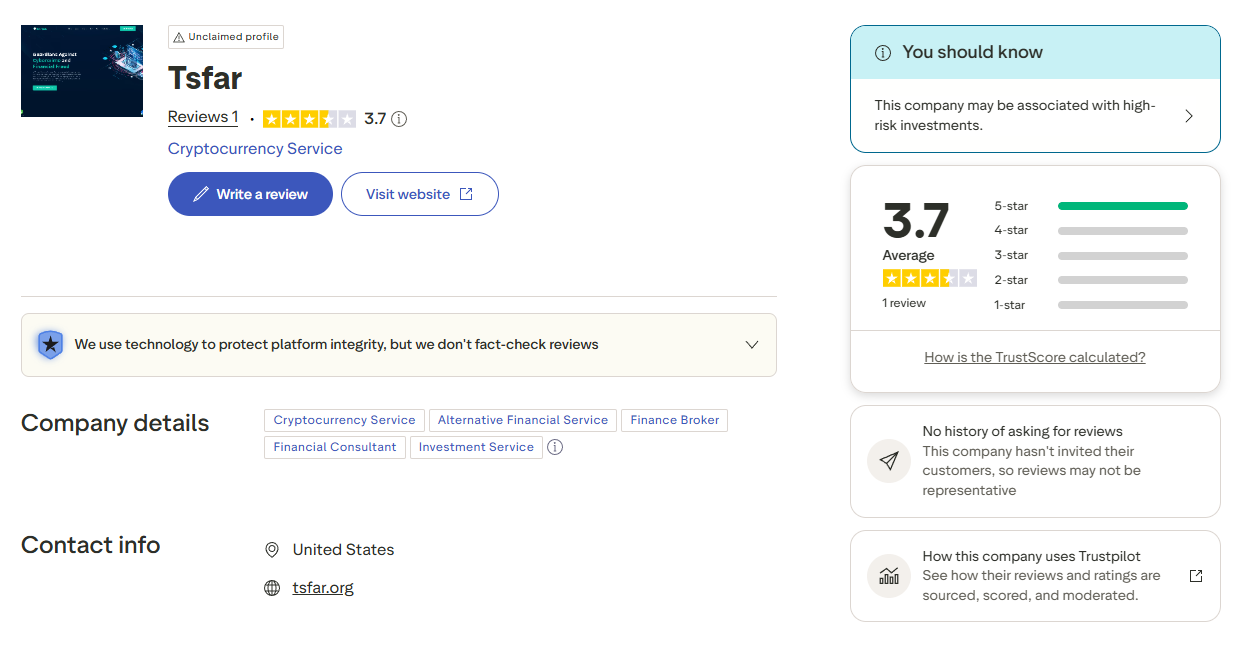
The only positive review does not describe a complex recovery of money from a broker, crypto platform, or investment scheme. In substance, it looks more like a general review about help with a “lost item.” Therefore, it cannot be used as evidence of successful recovery practice.
Searches for Trusted Solutions For Asset Recovery reviews give too few independent signals. We did not find a stable body of complaints about upfront payments, disappearing managers, additional charges, or no result. But there are also no confirmed positive cases. For a service that claims international assistance for fraud victims, such a weak public history does not add trust.
Scamadviser can be considered only as an additional source. In its domain analytics, it notes a low trust score, the young age of the domain, hidden WHOIS, and the website’s placement in the money recovery services category, where abuse is common. This is not proof of fraud, but it is a relevant secondary risk indicator.
What the Combined Facts Show
| Factor | What we saw | Why it matters |
| Legal entity | The full legal entity and registration number are not disclosed | It is unclear who provides the service |
| Domain age | Registered on 18.09.2025 | Does not confirm the claimed history |
| Contract | No service agreement found | The client does not see obligations before payment |
| Fee | Price list and fee schedule are not disclosed | It is impossible to assess the cost risk |
| Upfront payment | Not publicly confirmed or denied | Terms may be communicated only after contact |
| Guarantees | The Terms do not guarantee recovery | The marketing is broader than the legal obligations |
| GDPR / Privacy | A Privacy Policy exists, but no GDPR section was found | Disclosure is incomplete for EU clients |
| Banking data | CVV/passport are not requested at the first step | It is unclear what will be requested later |
| Regulatory warnings | No official warning for the exact brand was found | This is not the same as confirmed reliability |
| Real reviews | The reputational footprint is minimal | There is no stable confirmation of results |
Overall, the Trusted Solutions For Asset Recovery analysis shows not one isolated “red flag,” but a set of weak points: legal uncertainty, a recent privacy-protected domain, a lack of transparent terms, a weak reputation, and incomplete disclosure of data security practices.
Pros and Cons of Trusted Solutions For Asset Recovery
-
no official warning from a financial regulator was found for the exact brand or domain.
-
no verifiable legal entity is disclosed;
-
no registration number is provided;
-
no license or sector-specific registration is confirmed;
-
the geographic data conflicts with itself: California, Nebraska, and the Southern Ontario phone code;
-
the domain is young, while the claimed history appears older than the current registration;
-
the domain owner details are hidden;
-
no separate service agreement was found;
-
the Terms do not guarantee financial compensation;
-
there are no verifiable cases of successful fund recovery;
-
GDPR disclosure for an EU audience is incomplete;
-
there are few independent reviews;
Editorial Conclusion
Trusted Solutions For Asset Recovery cannot be considered a transparent and easily verifiable recovery service. We do not claim that the company is a fraudulent organization: the checked data does not contain a court decision or a direct official regulatory warning for the exact brand. However, for a trust-based fund recovery service, there are too many gaps.
The main risks are an unclear legal entity, the absence of a transparent payment model, the absence of a published contract, a weak reputational footprint, and incomplete disclosure of personal data processing. The promises of asset recovery look too broad, especially given that the Terms and Conditions directly do not guarantee financial compensation.
We would not treat the promised result as guaranteed. Sharing documents, bank statements, payment data, or crypto wallet details with this service requires additional checks: who legally accepts the data, where it is stored, what contract is signed, what fees are charged, and what happens if recovery is impossible.


They told me my case is very strong and money can be recovered, but first I must pay for investigation. After payment they ask another fee for legal documents, then one more for bank processing. I never received contract or clear report about what was done. Every time its new reason to pay, but no money returned and manager reply less and less.
I sent them bank statements, wallet address and all messages with the broker because they said its needed for recovery. Later I started asking who exactly is handling my documents and where company registered, nobody give normal answer. They only keep saying specialist will contact me soon. Now I regret sharing so much personal information with service I cannot verify.