
Conducting a Gerard McMann analysis, we saw a contradictory picture: the company presents itself as a modern financial platform from Montreal that uses artificial intelligence for trading and investment, but a closer check leaves too many open questions.
At the advertising level, everything looks confident: dozens of order types, thousands of active clients, a high satisfaction rate, international markets, and claims about account protection. But at the level of verifiable facts, the picture is much more troubling.
We do not claim that fraud has been established by a court or regulator. However, for a company that offers services involving money, trading accounts, and investment decisions, the level of transparency should be significantly higher. In this article, we examine what Gerard McMann claims, how long the website has existed, what the domain history shows, whether there are signs of real regulated activity, and how convincing the reviews look.

What Gerard McMann Says About Its Activities
According to its own materials, the company presents itself as a provider of trading and investment solutions. A PR Newswire publication dated March 26, 2026 says that Gerard McMann develops a platform with artificial intelligence-based tools, works with stocks, cryptocurrencies, futures, and other assets, and also offers more than 90 order types and access to data from more than 200 research sources.
In the same publications, the company claims to have 15,000 active traders, a 98% client satisfaction rate, and account protection through SIPC. The SIPC claim deserves special attention. SIPC is a U.S. organization created to protect clients of broker-dealers in the United States: it becomes relevant when a brokerage firm that is a SIPC member suffers financial failure and client assets become unavailable.
For a company that publicly positions itself as a Canadian financial platform from Montreal, the reference to SIPC looks illogical.
A Canadian broker should have a clear connection to Canadian regulators and protection structures, rather than an abstract reference to the U.S. system. During the check, we could not find confirmation that Gerard McMann participates in SIPC; the open materials also do not disclose the broker-dealer through which client accounts could supposedly receive such protection. Therefore, the SIPC claim looks not like a real guarantee, but like part of a poorly constructed marketing legend.
| Company Claim | Why It Matters | What Raises Questions |
| 15,000 active traders | Suggests an allegedly large client base | The public footprint looks too weak for such a scale |
| 98% client satisfaction | Should confirm the quality of service | The figure is based on the company’s own claims |
| More than 90 order types | Suggests developed trading infrastructure | Detailed trade execution conditions are not disclosed |
| Account protection through SIPC | Should reduce client risk | For a Canadian company, such a reference looks illogical, and Gerard McMann’s participation in SIPC is not confirmed. |
| Address in Montreal | Creates the impression of a connection to Canadian jurisdiction | No office number or specific premises are disclosed |
The main question here is not whether the company can describe its services attractively. The question is how closely the stated facts match reality.
Gerardmcmann.com Analysis: What the Domain Check Shows
To check the domain, we used ICANN Lookup — the official service of ICANN, the organization that coordinates the domain name system. This tool allows users to view basic registration information: domain creation date, registrar, registration term, and part of the available technical information.
According to the collected data, the domain gerardmcmann.com was registered on February 5, 2020; the registrar is NameCheap, and the current registration term is listed until February 5, 2027. The domain data also shows an update in March 2026. These details are important, but by themselves they do not prove that the financial business has operated since 2020.
| Parameter | What Was Found |
| Domain | gerardmcmann.com |
| Registration date | February 5, 2020 |
| Registrar | NameCheap |
| DNS infrastructure | Cloudflare |
| Significant update | March 2026 |
| Key conclusion | the domain is old, but the current financial brand looks new |
It is important to separate the age of a domain from the age of a company. A domain may exist for many years while being used for different projects. This is exactly what can be seen in the history of gerardmcmann.com.
Website History in the Web Archive
To see what the website looked like before, we used the Wayback Machine — a web archive that stores old versions of pages. Archived snapshots show that the domain was not always connected with financial services.
According to the collected dossier, the website was previously used as a page connected with the musical context of Gerard McMann/G Tom Mac; then, in 2023–2024, it hosted a general consulting blog with the headline “Consulting Is Awesome — And You Can Do It, Too.” Only in 2026 did the domain begin to look like the website of a financial platform.
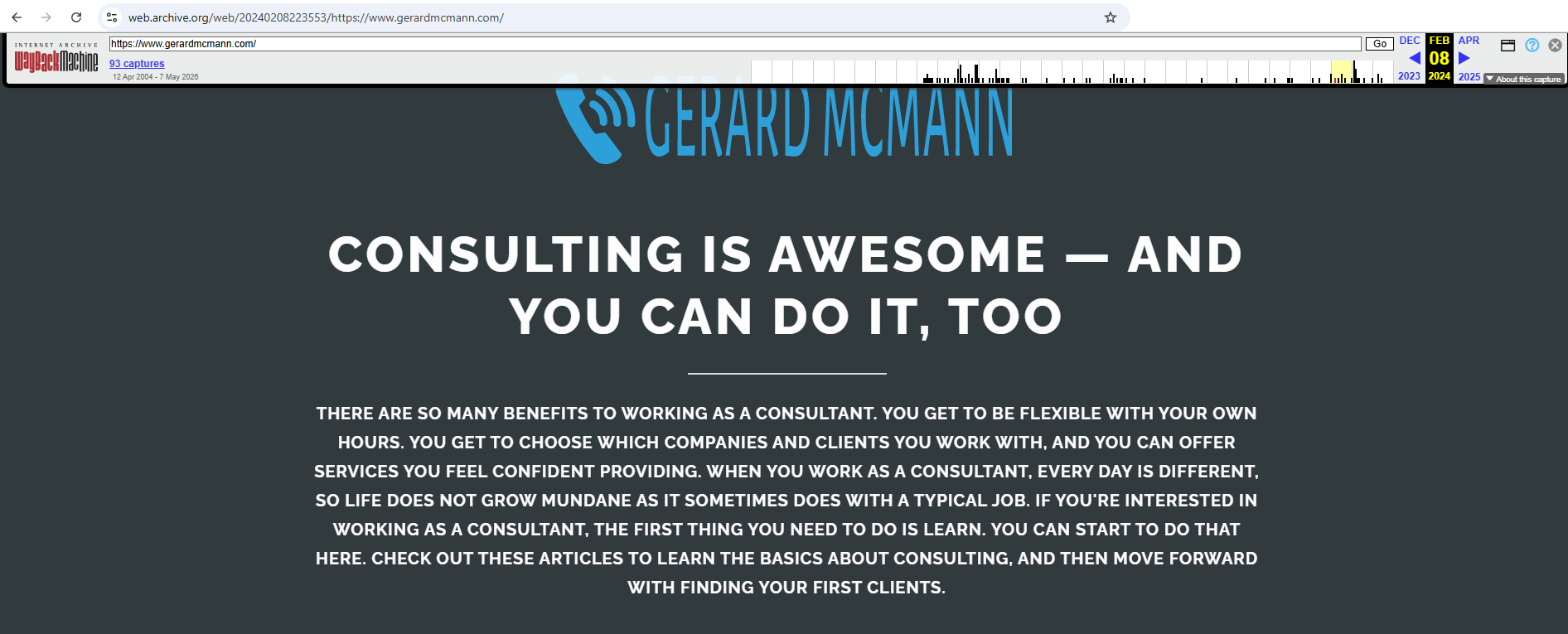
This does not automatically prove fraud, but it shows that the domain history does not confirm long and continuous operation of this exact financial company. If a brand claims visible scale, thousands of clients, and serious infrastructure, such a change in website topic requires an explanation.
Legal Transparency and License
The most important question for any financial platform is its legal status. A bona fide broker or investment intermediary should provide clear information: full legal entity name, registration number, jurisdiction, license, regulator, office address, responsible persons, and documents that can be checked in official registers.
In the open materials on Gerard McMann, we do not see a sufficient set of such data. The company provides an address, email, and phone numbers, but does not disclose a clear legal entity number, license number, name of the regulated participant, broker-dealer, or custodian of client funds.
For a Canadian financial company, checking through the regulatory infrastructure is especially important. CIRO states that it regulates investment dealers, mutual fund dealers, and their representatives across Canada. On the Dealers We Regulate page, organizations can be searched by name, province, or city.
When checked by the name Gerard McMann, no matches were found in this register.
This is a fundamental point: a financial company cannot simply “not disclose” its legal name if it claims to be a regulated intermediary. If a company does not disclose its legal entity and is not found in the register of regulated dealers, its claims about legal brokerage activity in Canada look unreliable and are not supported by the public regulatory record.

Address in Montreal: A Real Complex, but Weak Evidence of Presence
The Gerard McMann website lists the address 150 Sainte-Catherine Street West, Montreal. This is the real address of the large Complexe Desjardins in Montreal. The existence of the building itself is confirmed, but this is not enough to confirm the presence of a specific financial company there.
During our check, we found that Gerard McMann’s public materials do not state an office number, premises, floor, tower, or specific local contact. Open directories of Complexe Desjardins list dozens of organizations and tenants associated with this address, but Gerard McMann does not appear among them.
For a company claiming international financial activity and thousands of active clients, the absence of a verifiable address footprint looks like a weak point.
Sometimes questionable projects use well-known business or mixed-use complexes as an image shield. In the case of Gerard McMann, this is especially noticeable: a company of the claimed scale would hardly be expected to “get lost” among tenants and leave no verifiable trace at the stated address.
Gerard McMann Reviews: What Trustpilot Shows
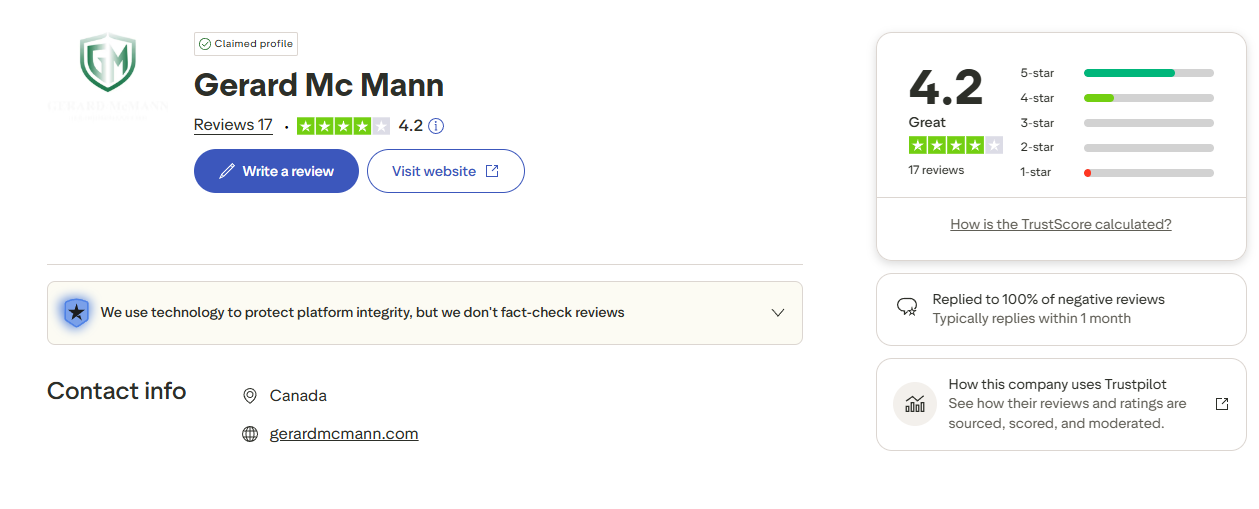
The company’s Trustpilot profile shows a rating of around 4.2–4.3 based on 17 reviews at the time of the check. In positive comments, users praise support, withdrawals, platform convenience, trading conditions, and access to markets.
However, good ratings by themselves are not proof of reliability. It is important to look at the structure of reviews, publication dates, language, repeated wording, and how the reviews correspond to the company’s actual history.
In this case, the positive texts look rather marketing-like. They often repeat the same ideas found in promotional materials: artificial intelligence, fast trades, convenient withdrawals, support, and broad market access. Against this background, a negative review stands out with a complaint about intrusive calls: the user describes more than 30 calls in one week after leaving contact details.
We do not draw a conclusion based only on one negative review. But when such a review appears alongside an opaque legal section, an old repurposed domain, and active promotional activity, it strengthens the overall risk profile.
Main Risk Indicators
Based on the check, we identify several factors that potential clients should consider before transferring data or money.
- Opaque legal structure. There is not enough publicly available information about the legal entity, license, regulator, and custodian of client funds.
- Old domain with unrelated history. The web archive shows that the website was previously used for topics unrelated to financial services.
- Mismatch between claims and public footprint. The company speaks of 15,000 active traders and 98% satisfaction, but the independent public footprint looks too weak for such a scale.
- Address without precise office details. A large complex in Montreal is listed, but no specific office or premises are provided.
- Mixed picture with reviews. A high rating stands next to complaints about aggressive calls and the marketing tone of positive comments.
What to Check Before Any Contact
Before registration, document submission, or money transfer, a potential client should request the following from company representatives:
- full legal name;
- registration number;
- country and province of registration;
- license number;
- link to the company’s profile in the regulator’s register;
- name of the regulated participant through which services are provided;
- details of the organization that holds client funds;
- service agreement;
- full payment recipient details;
- deposit and withdrawal rules;
- exact office address with premises number.
If, instead of these details, a client receives only a presentation, calls from a manager, and promises of quick profit, this is a serious reason to stop. In finance, lack of transparency before a deposit almost always works against the client.
Pros and Cons of Gerard McMann
-
The website looks visually professional and describes trading opportunities in detail.
-
The company has a Trustpilot profile and a number of user reviews.
-
The domain was not created from scratch; it was registered back in 2020.
-
The company’s full legal structure is not disclosed.
-
There is not enough transparent information about its license and regulatory status.
-
The domain history does not match the image of a long-operating financial platform.
-
The web archive shows that the website was previously used for unrelated topics.
-
Claims about 15,000 active traders and 98% satisfaction are not supported by independent evidence.
-
The reviews look mixed: positive texts sometimes resemble advertising, while negative complaints point to possible aggressive calling.
-
It is unclear who exactly receives and holds client funds.
Final Conclusion
Our editorial team evaluates Gerard McMann not merely as a high-risk financial project, but as a scam platform with signs of a fake brokerage façade. The key reason is the absence of a verifiable legal basis: the company does not disclose its legal entity, does not confirm a license, is not found in the relevant Canadian register of regulated dealers, and uses marketing claims that are not supported by independent evidence.
Three circumstances are most important to us. First, the domain history shows a change of topic, so the age of the website cannot be used as proof of long-term operation of a financial company. Second, the project lacks transparent verification of its license and legal entity. Third, the claimed scale — thousands of active clients and international activity — does not match the weak independent footprint in the professional environment.
By all indications, Gerard McMann is a fake financial company rather than a real regulated broker. Potential clients should not provide personal data, pass verification, or transfer money to it.


I only leave my phone number because I wanted to know account conditions, after this they start calling me almost every day. Every manager tell different story about AI trading and protected money, but no one can send real license. When I said I will not deposit now, they call again from other numbers. Very annoying and not professional.
At beginning everything look very professional and manager was friendly with me. He convinced me to add more money because system showing “very good signals”. But when I wanted withdrawal, they ask more documents and one more payment. I refused to pay again and now nobody answer me. Money still showing on account but I cannot take it.