
The Foxbux analysis indicates a high level of risk: the service claims to help with fund recovery, crypto recovery, scam investigation and fraud tracing, but provides insufficient verifiable legal information. The domain was created in April 2026, while public payment terms, a contract, a refund policy and real outcome guarantees could not be confirmed on the website. In this context, transferring money, documents and personal data requires particular caution.
How We Reviewed Foxbux
We compared several groups of data:
- the company website and service-description pages;
- contact details and the stated address;
- the availability of legal documents;
- Terms and Conditions, Privacy Policy and Refund Policy;
- domain information through ICANN Lookup / RDAP;
- open business registers and regulatory lists;
- warning lists and general regulator warnings about recovery room scams;
- reviews, review platforms and online mentions;
- similar websites with the same recovery-focused positioning.
For fund recovery companies, verifiable legal and contractual indicators matter more than promotional promises. A user should understand who is providing the service, where the company is registered, what contract is being concluded, what the work costs, whether an upfront payment is required, and in which jurisdiction a claim can be brought.
It is also important to understand how the service intends to interact with banks, payment systems, crypto exchanges or law-enforcement bodies. If a company promises to recover money but does not explain its mechanism of work or authority, the service requires additional verification before documents or payment are provided. Therefore, a Foxbux analysis must take into account not only the website and promotional wording, but also how verifiable the service model itself appears to be.
For details of our sources, assessment principles and Expert Rating, see our editorial standards and review methodology.
What Foxbux Claims About Itself
The website describes the project as a service in cybersecurity and digital recovery. Its list of services includes areas related to investigating online fraud and recovering assets.
Foxbux lists the following services:
- crypto tracing and recovery;
- fund recovery;
- scam investigation;
- asset recovery;
- data breach response;
- cybersecurity audits;
- crypto and scam intelligence reporting.
The service addresses people who may have lost money to online brokers, crypto platforms, investment projects or other digital schemes. Its promotional blocks use wording about locating fraudsters, tracing stolen crypto assets and helping recover funds.
The performance claims deserve separate attention. The website refers to a 98% client success rate, thousands of clients worldwide, and stories in which a substantial portion of funds was allegedly recovered within a short period.
Such claims require evidence. In the public part of the website, we did not find:
- a methodology for calculating the success rate;
- a list of court cases;
- official case or proceeding numbers;
- confirmation from banks or payment systems;
- audited statistics;
- independent confirmation of client cases.

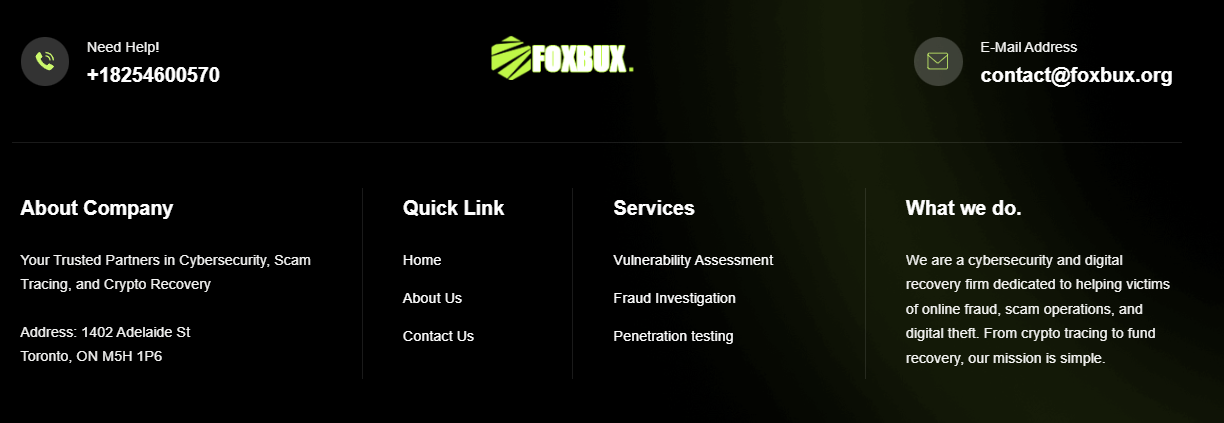
The website provides a telephone number, email and a Canadian address: 1402 Adelaide St, Toronto, ON M5H 1P6. However, it does not disclose the full legal name, registration number, director, governing law, licence or professional registration.
This might be less critical for an ordinary information website. However, for a service that offers fund recovery assistance and may obtain access to bank statements, documents and transaction data, incomplete identification of the operator is a material risk factor. This is why fund recovery through Foxbux cannot be assessed solely by the promises made on its landing page.
What the foxbux.org Domain Check Shows
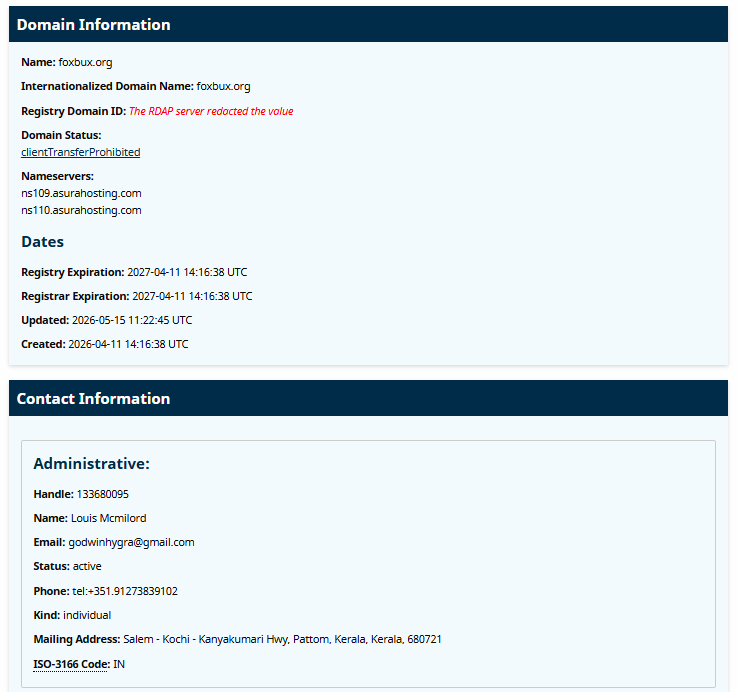
For the domain review, ICANN Lookup and RDAP data were used. These tools can show the domain creation date, registrar, registration expiry date, domain status, nameservers and part of the contact information.
| Parameter | Data |
| Domain | foxbux.org |
| Creation date | 11 April 2026, 14:16:38 UTC |
| Update date | 15 May 2026, 11:22:45 UTC |
| Registration expiry | 11 April 2027 |
| Registrar | PDR Ltd. d/b/a PublicDomainRegistry.com |
| Registrar IANA ID | 303 |
| Domain status | clientTransferProhibited |
| Nameservers | ns109.asurahosting.com, ns110.asurahosting.com |
| DNSSEC | Unsigned |
| RDAP contact | individual, country — India |
| Registry Domain ID | value hidden by the RDAP server |
A young domain does not by itself prove misconduct. However, the foxbux.org data matter in the context of claims about thousands of clients, a high recovery success rate and broad expertise in crypto recovery.
If the Foxbux website was created only in April 2026 yet already claims extensive international practice, the editorial team would expect further evidence: company history, a legal entity, public cases, documents, professional registrations or a stable independent reputation trail.
A further question arises from the difference between the public positioning and the domain record. The website gives a Canadian address, while the RDAP contact is linked to an individual and the country India. This is not evidence of a violation, but it requires an explanation from the service.
Foxbux Service Terms: Payment, Fees, Contract and Guarantees
The public service terms are disclosed incompletely. The website did not allow us to confirm documents and parameters that are normally important for a recovery-service client.
| Parameter | What Could Be Confirmed |
| Public price list | Not confirmed |
| Upfront payment | Not disclosed |
| Success fee | Not stated |
| Service contract | Not confirmed |
| Refund Policy | Not confirmed |
| Payment methods | Not disclosed |
| Jurisdiction | Not disclosed |
| Guarantees | The website uses recovery-success claims, but no public contractual guarantee was confirmed |
| Identity of the service provider | Not disclosed in a verifiable form |
| Connection with banks / exchanges | Not confirmed |
| Case procedure | Not described in sufficient detail |
For a chargeback service, this is a serious gap. A client should understand in advance not only the total cost, but also whether an advance payment is expected, whether a percentage of recovered funds is charged, and whether payment can be refunded if there is no result. It is equally important to see which legal entity will be named in the contract, which jurisdiction applies, which documents must be provided, and who will access banking and personal data. Without this information, a user cannot assess realistic timelines, the scope of the service’s responsibility or what actions the company can actually take.
The issue of guarantees is particularly important. Fund recovery cannot be promised universally: the outcome depends on the payment type, deadlines, bank, payment system, recipient’s jurisdiction, evidence, and the willingness of financial institutions or law-enforcement bodies to participate in the process.
The situation is even more complex for cryptocurrency transactions. Such transfers cannot simply be reversed at the request of a client or a private company. The possibility of recovery usually depends on identifying the recipient, movement of funds through a centralised exchange, freezing assets, contacting law enforcement or court proceedings.
Against this background, a promise of a high recovery success rate without reviewing the specific case appears too strong and calls for caution. Chargeback through Foxbux is also not described as a separate transparent procedure: the website does not disclose who prepares the documents, how dispute timelines are assessed, or in which cases a client may be refused assistance.
Legal Transparency and Regulatory Footprint
We could not confirm a registered legal entity behind the service on foxbux.org. The website does not disclose a company number, registration authority, director, licence, professional registration or the legal entity’s address.
This makes it impossible to verify confidently:
- whether the company exists as a registered entity;
- whether the brand name matches the legal entity;
- who is responsible to the client;
- in which country a claim can be filed;
- which law applies to the contract;
- whether its representatives have professional status;
- whether the service is entitled to claim it provides legal or financial assistance.
No direct public regulator warning specifically concerning Foxbux was confirmed in the data reviewed. This is an important limitation: the service cannot be described as fraudulent as an established fact.
However, the absence of a warning does not mean that the company has passed a reliable verification. Regulators in different countries separately warn about recovery room scams — schemes in which people who have already lost money are offered recovery in exchange for a further payment. For this category of service, transparency about the contract, legal entity and fees is essential.
The website also did not allow us to confirm real links with banks, payment systems, crypto exchanges, regulators or law-enforcement bodies. If a company claims cooperation with financial institutions and legal authorities, a user should see specific grounds: official documents, partnerships, licences, mandates or at least a clear description of the procedure.
Foxbux Reviews: What Is Visible on Online Platforms
Foxbux reviews in the independent sphere appear limited compared with the scale of promises on the website. We did not find a stable body of independent reviews matching the claims of thousands of clients and high effectiveness.
The website itself forms the main reputation block through testimonials. Such reviews may be part of marketing, but they do not replace a verifiable reputation. They lack data that would make it possible to confirm the reality of the cases:
- dates of contact;
- documents;
- case numbers;
- bank confirmation;
- court decisions;
- links to independent sources;
- a detailed description of the recovery procedure.
A separate search for reviews and mentions linked to foxbux.org likewise does not show a stable, independent reputation picture. For a project claiming international practice and thousands of clients, the lack of a noticeable external footprint appears to be a weakness.
There are isolated online mentions of the service in the context of complaints about financial platforms. Such a trace can be considered only an additional signal. It proves neither service quality nor misconduct, but shows that the reputation picture requires closer review.
For a service that may request documents, personal data and payment for fund recovery, a weak independent footprint increases uncertainty. If a company claims thousands of clients, it is reasonable to expect a more visible and verifiable history outside its own website.
Similar Websites and a Possible Recovery-Network Template
A separate risk factor is Foxbux’s near-complete similarity to other websites in the recovery-services niche. In design, visual structure and presentation logic, the website effectively replicates termix.cc and viang.org, while Qoxil and Pontib use similar positioning, comparable wording, analogous service blocks and matching elements, including the Toronto address.
| Website | Matching indicators |
| qoxil.org | Similar cyber trace / crypto recovery positioning, the same address, and a closely related structure |
| viang.org | Similar service template and recovery rhetoric |
| termix.cc | Similar design and stated service set |
| pontib.com | Similar recovery positioning and service descriptions |
A matching template does not automatically prove a common owner. However, it is an important signal for a client. A trustworthy company normally builds confidence through an established brand, a legal entity, a clear contract, verifiable contacts and a transparent operating history.

When similar recovery websites use the same address, closely related text and the same promise logic, this reduces confidence in the uniqueness and verifiability of the claimed expertise.

Against this background, Foxbux appears not as an isolated brand with a well-substantiated history, but as part of a broader network of template-based websites.
Risks for a Client Contacting a Fund Recovery Service
The main risk is losing money again. People who have already suffered losses to a broker, crypto project or investment platform often look for a quick way to recover funds. In this setting, promises of near-guaranteed recovery can appear persuasive.
Potential risks of contacting a non-transparent service:
- an advance payment without a clear contract;
- pressure to make additional payments;
- no guarantee of an outcome;
- inability to verify who is actually handling the case;
- providing a passport, bank statements and transaction data to an unknown operator;
- risk of personal-data leakage;
- difficulty bringing a claim if the legal entity is unverified;
- use of strong wording without legal specifics.
These risks do not mean that every client has already suffered harm. However, they show why documents and verifiable company details should be requested before contacting a fund recovery service.
Particular caution is needed when a service requests a passport or ID, bank statements, screenshots of an account dashboard, card details, crypto wallet addresses, correspondence with a broker, transfer documents, or access to email and accounts. Such information may be necessary for a genuine case review, but only under a clear contract, with a verified legal entity and a transparent data-processing policy. A seed phrase, private keys, access codes and one-time passwords must never be shared with any recovery service: public wallet addresses and transaction hashes are normally sufficient for analysing cryptocurrency transactions.
What the Evidence Shows
| Factor | Why It Matters |
| Domain created on 11 April 2026 | A young domain history fits poorly with claims of thousands of clients |
| Legal entity not confirmed | It is difficult for a client to understand who is responsible |
| RDAP contact linked to an individual and India | This does not match the Canadian positioning on the website |
| Public contract and payment terms not confirmed | The client cannot assess the cost, procedure or conditions for a refund |
| High recovery-success claims not independently supported | The statements need documentary or statistical evidence |
| No stable independent reputation trail found | This is not consistent with claims of broad international practice |
| Similar recovery websites found | The repeated template, wording and address increase uncertainty |
| No direct Foxbux regulator warning confirmed | This does not establish misconduct, but does not remove the transparency concerns |
| Work with documents and personal data may be required | The client needs a verified operator and clear data-protection conditions |
Individual indicators do not prove misconduct by themselves. Taken together, however, they point to insufficient transparency for a service working with money, documents and sensitive personal data. In this sense, the Foxbux analysis is not about one isolated weakness but the overall picture: too many important parameters remain unconfirmed.
Foxbux Pros and Cons
-
The website is operational and provides information about the services offered.
-
A telephone number, email address, and physical address are provided.
-
The legal entity behind the service could not be confirmed.
-
No company registration number is disclosed.
-
No relevant licence or professional registration could be confirmed.
-
Payment terms are only partially disclosed.
-
No publicly available service agreement could be found.
-
No evidence was found to support the claimed links with banks, exchanges, or law-enforcement bodies.
-
Similar asset-recovery websites using the same address and a highly similar template were identified.
Editorial Conclusion
We found insufficient grounds to consider Foxbux a transparent and reliable fund recovery service. The principal concerns relate to legal identification, payment terms, confirmation of professional status and the realism of the claimed recovery outcomes.
No direct official regulator warning concerning this brand was confirmed in the data reviewed. Therefore, the accurate assessment is not established fraud, but high risk and insufficient transparency.
Before providing money, documents or personal data, a user should request the company’s full legal name, registration number, country of registration, a written contract, the exact service cost, advance-payment terms, the size of any success fee, the refund policy and details of the specialist who will handle the case. It is also important to obtain a written description of the mechanism for working with a bank, payment system or law-enforcement body, plus separate confirmation that recovery is not guaranteed.
Our editorial conclusion: Foxbux appears high risk. The risk of further financial losses and disclosing sensitive data to an unknown operator is assessed as high. Before contacting the service through foxbux.org, its legal details, payment terms and the actual authority of its representatives should be checked separately.


They said they found my crypto and can return it fast. First I paid one fee, then they asked more money for compliance and verification. I paid again because they said this is last step. Nothing came to my wallet. Now support always have new excuse and ask for another payment. I understand too late that I was just sending money again and again.
The consultant was very friendly and talked like they already know where my money is. I almost sent passport and all bank statements, but decided to check company first. Same Toronto address was on few other recovery sites and they look almost identical. I asked about legal company and contract, but he changed topic every time. After this I stopped contact.