
Our Copyaegon analysis indicates a high level of risk: the platform does not disclose its legal operator or a verifiable licence, while its claimed history since 2006 is inconsistent with the age of the domain. The large sums required by its plans, conflicting leverage figures and traces of another brand in the client portal raise further questions.
How We Reviewed Copyaegon
Copyaegon was assessed across four areas:
- Official website copyaegon.net. We recorded the claimed history, regulatory reach, plans, commissions, leverage and promises to protect client funds.
- Legal transparency. On the contact page and in the documents, we looked for the operator’s name, registration number, contractual jurisdiction, licence and information about the payment recipient.
- Domain history. We checked the registration date and technical data through ICANN Lookup and RDAP, and searched for the earliest public versions of the website in the Wayback Machine.
- Regulatory status. We compared the company’s claims with the registers and warning lists of the FCA, CySEC, BaFin, AMF, CONSOB and FINMA. We also reviewed the Bank of Russia entry, considering only confirmed matches between brands and domains.
We did not open an account or transfer funds, so we did not assess actual trade execution or the processing of withdrawal requests. The article’s conclusions concern the platform’s public transparency and the information a client can verify before funding an account.
Learn more about our editorial policy.
What Copyaegon Claims About Itself
The website presents the platform as an international broker and copy-trading service. The About section and homepage claim:
- that it has operated since 2006;
- more than 350,000 traders, “millions” of users across 40+ countries and over 500,000 trades per day;
- regulation in Europe, Australia, Japan, the BVI, the UAE and South Africa;
- paid-up capital exceeding $122 million;
- client funds held in segregated accounts;
- leverage up to 500:1, spreads from 0.0 pips and “guaranteed profit”.
These Copyaegon claims do appear on the website, but their substance is not supported by independent documentation. No financial statements, audit reports or information linking the capital and client accounts to a specific legal entity are provided. The figures therefore remain marketing claims.
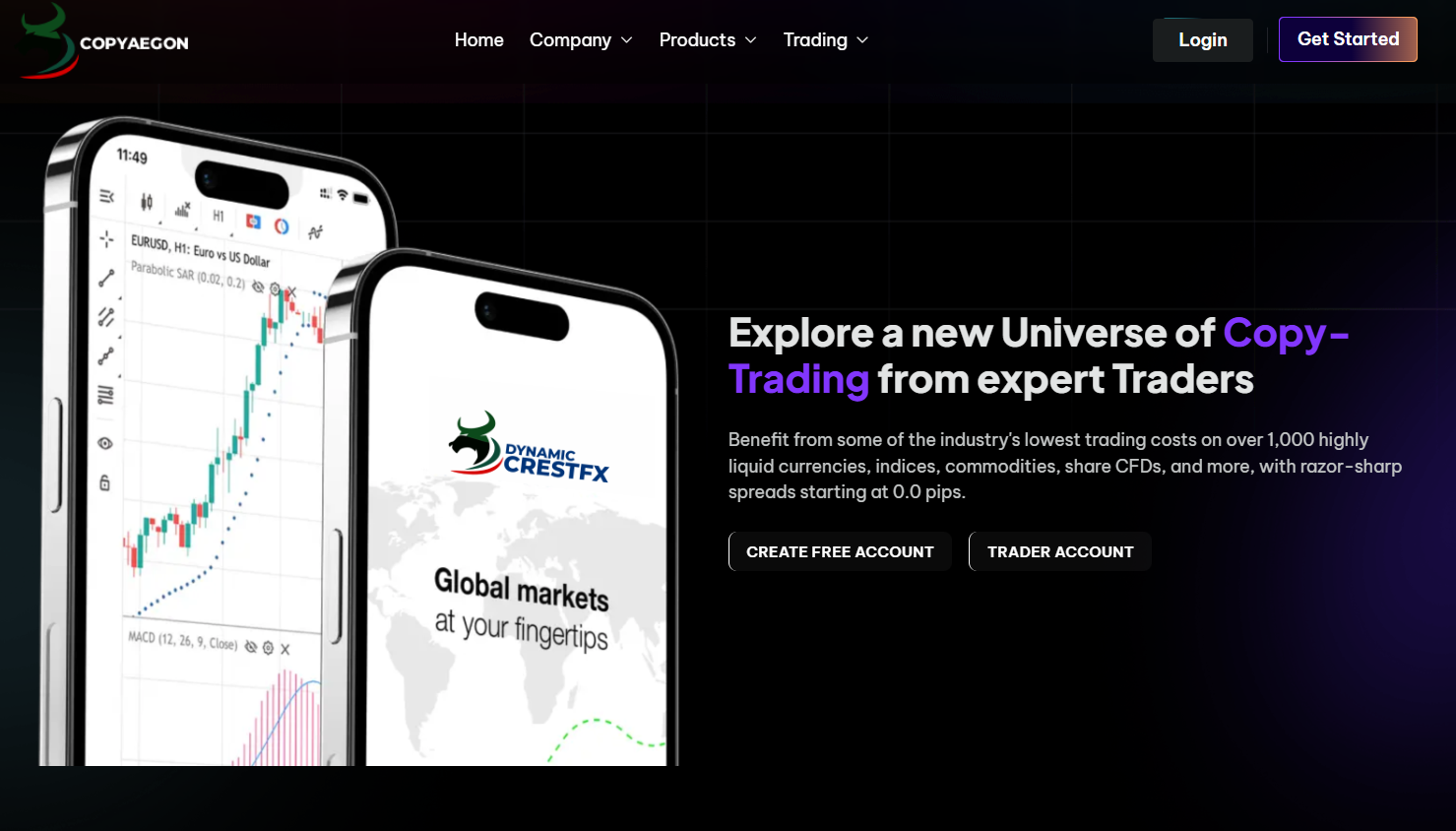
It is particularly telling that different pages mix several measures of audience size. The figure of 350,000 is described as the platform’s number of traders, while the website separately refers to the trust of millions of users. The invitation to “join 50 million traders and investors” is worded in a way that prevents it from being treated confidently as the company’s client count. The methodology and measurement period are not explained.
Copy trading on the website appears to be part of the overall positioning rather than a fully developed standalone product. Copyaegon does not disclose:
- a catalogue of strategy providers and the criteria used to select them;
- verified returns, drawdowns and risk metrics;
- rules for disabling underperforming strategies;
- controls for loss limits, position sizing and stopping copying;
- potential discrepancies between a provider’s trades and a subscriber’s results.
Public information therefore reveals no material advantages over other copy-trading services.
Attractive statistics on a homepage are not enough to verify such claims. A prospective client needs the name of the contracting entity, corporate financial statements, a licence number and an entry in the supervisory authority’s register. Without these, it is impossible to establish whether the capital, trading volume and client base relate specifically to this project or form part of a generic advertising template.
copyaegon.net: Domain and Website History
ICANN Lookup is ICANN’s official service showing the domain creation date, registrar, registration period, name servers and some technical data. The information was also cross-checked through RDAP.
| Parameter | Value |
| Creation date | 20 February 2025 |
| Registrar | GO54 Limited |
| Registration period | until 20 February 2027 |
| Last record update | 19 February 2026 |
| Registrant details | hidden via Privacy Protect LLC |
The domain was registered almost nineteen years after the claimed founding date. The first version found in the Wayback Machine is dated 22 February 2025—two days after registration. Copyaegon may previously have operated under another address, but no previous domain, legal name or succession is disclosed. The website’s history does not substantiate operations since 2006.

Using a privacy service to conceal the registrant’s contact details is not a violation, but combined with an undisclosed operator it reduces the ability to verify who receives client funds.
It is important not to overstate the significance of the domain’s age. A new registration may result from rebranding or migration, so it does not prove that the company was established only in 2025. The problem is the missing chain of continuity: the website does not identify a previous address, provide archived documents or explain which legal entity conducted the claimed business in earlier years.
That chain could reconcile the young domain with the claimed history since 2006. In its absence, only the existence of the current website since February 2025 is supported—not an operating record of almost twenty years as a financial organisation.
Who Operates the Platform and Where Is the Licence?
Copyaegon does not disclose the legal operator’s name, registration number, contractual jurisdiction, licence number or a link to an official register. On the Contact Us page, the Office Address and Dial fields are blank; only an email address is listed.
The statement that the platform is regulated “in Europe” cannot be verified without the organisation’s name and supervisory authority. We found no authorisation record or specific warning for the brand or domain in the registers and warning lists of the FCA, CySEC, BaFin, AMF, CONSOB and FINMA. The absence of a warning does not amount to authorisation, while the undisclosed operator makes it impossible to search by legal entity.
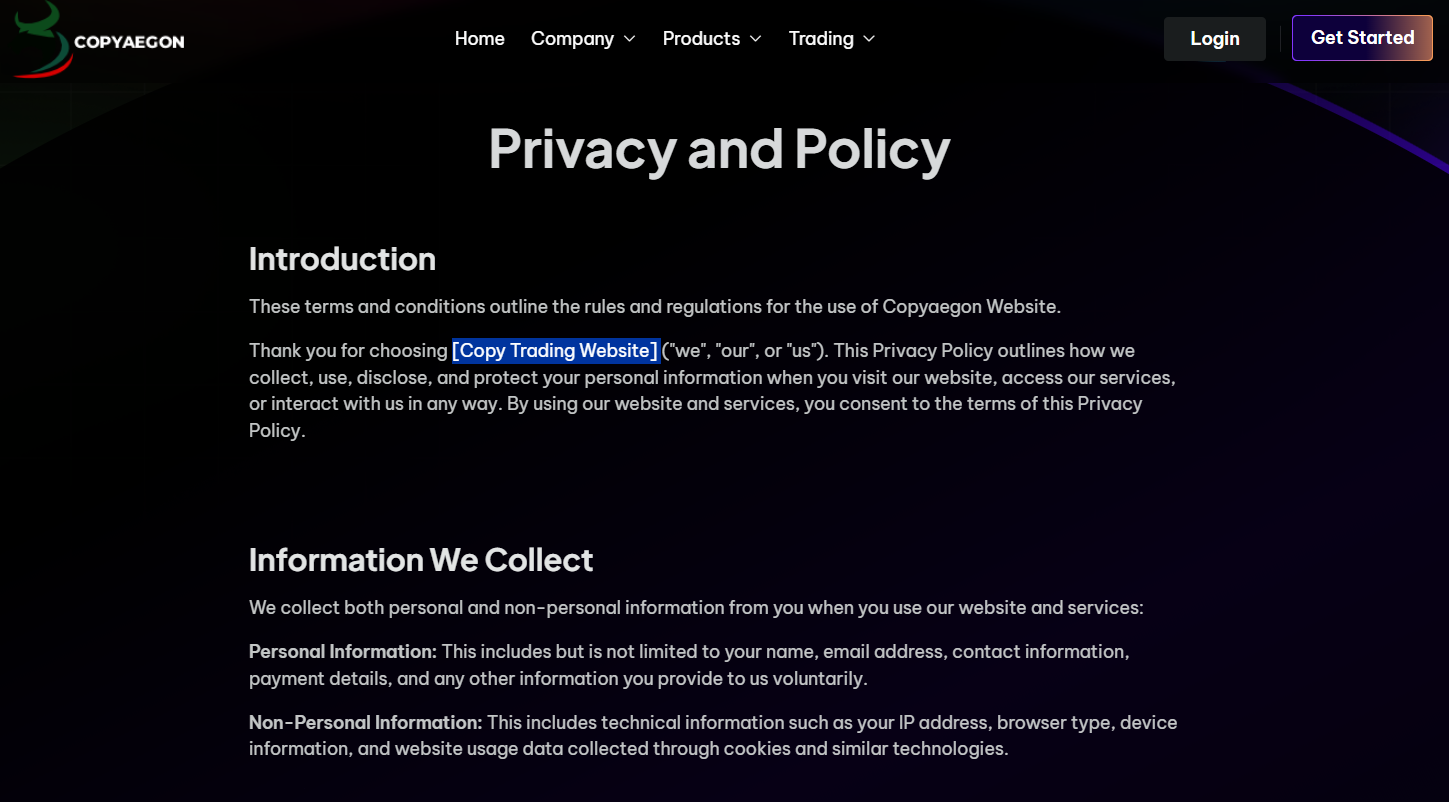
All four links—Privacy Policy, Terms of Use, Terms & Conditions and Risk Disclosure—lead to the same text containing the [Copy Trading Website] placeholder. The data controller and governing law are not specified; there is no complete contract, separate risk disclosure or AML/KYC Policy.
Consequently, a user cannot identify the contracting party, the payment recipient or the entity responsible for processing documents.
This is more than a formatting flaw. Without a legal operator, it is impossible to verify the financial services it is permitted to provide, participation in an investor compensation scheme or the authority to which a complaint should be submitted. It is also unclear which country has jurisdiction over a dispute and whether the payment recipient is the party to the user agreement.
The Privacy Policy states that contact, technical and payment data are collected, but does not identify the organisation controlling them. We do not claim that this automatically breaches the GDPR or other legislation. However, providing a passport, payment details and proof of address to an unknown controller creates a separate risk regardless of the trading outcome.
Copyaegon Plans, Leverage and Protection Claims
Copyaegon plans are presented through cards and promotional descriptions rather than a single agreement setting out the parties’ rights and obligations.
| Parameter | Published information |
| USD plans | deposit ranges from $10,000 to $2 million |
| Cryptocurrency plans | ranges from 1 to 100 BTC |
| PIPS figure | from 30–35% to 200%, depending on the plan |
| Commission | 10% Trade Commission across all displayed plans |
| Leverage | 500:1 on the About page; up to 1:1000 for certain markets; both 1:200 and 1:5 stated for crypto CFDs |
| Trade protection | reimbursement of losses up to $1 million claimed for an additional fee |
The website does not explain what the PIPS percentages mean, the calculation period or the nature of the metric. They cannot be described as promised returns, but with a minimum contribution of $10,000, the ambiguity creates a risk that the offer will be misunderstood.
In standard trading terminology, a pip is a unit of price movement, not a percentage return on a plan. Phrases such as “30–35% PIPS” or “200% PIPS” therefore require a separate formula and worked example. Without them, a client cannot tell whether the card promises a result, describes a trading target or uses the term solely as a marketing label.
The contribution ranges are also unusually large for an offering aimed at a broad audience. The upper tiers reach $2 million and 100 BTC, yet there is no bespoke agreement, information on the custody of crypto-assets, payment-entity details or procedure for reversing an erroneous transfer. These gaps are particularly material for irreversible cryptocurrency transactions.
There are internal inconsistencies: “no commissions” appears alongside a 10% commission, leverage ranges from 500:1 to 1:1000, and two different figures are given for cryptocurrencies. The website does not disclose margin-call and stop-out levels, negative balance protection, the execution model, grounds for delaying withdrawals or the payment recipient.
For EU retail CFD clients, leverage limits range from 30:1 to 2:1; ESMA confirms that permanent national measures remain in force across all EU countries. For leverage up to 1:1000, the website does not explain the jurisdiction, client classification or legal basis.
The Security of Funds page promises to protect a trade against losses of up to $1 million and credit compensation. However, no external guarantor, coverage agreement, financial backing, exclusions or dispute procedure are disclosed. Promotional copy is insufficient to treat the protection as substantiated.
In substance, the offer resembles internal insurance for an individual position in return for an additional fee. But Copyaegon does not explain whether compensation is paid as real money, internal credit or a bonus, who funds the reserve, or what happens if the operator becomes insolvent. Protection of up to $1 million sounds substantial, but its practical value depends on terms that are not publicly available.
Similar Websites and Copied Content
Copyaegon’s design is not the only aspect that matches the Market Copy Pros website. The names Mark Villomas, Ufqad Warraich, Mario and Arshad Cervantes and nearly verbatim testimonials are repeated. In the final testimonial on both websites, an instruction was left in place stating which personal qualities and problem-solving approach should be added.

The [Copy Trading Website] placeholder, statistics and description of protection up to $1 million also match. Market Copy Pros calls the product PrimaProtect; in the other version, this word is replaced by the brand. The similarities support the use of a shared content template or copying, but do not establish common ownership of the websites.
An identical design alone could be explained by a purchased theme. Verbatim testimonials with the same unusual names, an unfilled instruction inside a customer story and the same error in a legal document carry greater evidential weight. They show that not only visual elements were transferred, but also materials that should describe genuine client experiences and the individual rules of a specific company.
Copyaegon Reviews: What Is Known About Its Reputation
A search for “copyaegon.net reviews” reveals no convincing independent footprint. This does not prove a breach or widespread withdrawal problems. But the almost complete absence of a verifiable history is disproportionate to the claims of operating since 2006 and serving 350,000 traders.
Testimonials on the official website are not independent: the matching names and texts from another project, along with the editorial instruction, show that the section is template-based. Taken together, the young domain, undisclosed operator, large contributions, inconsistent terms and traces of Dynamiccrestfx create the profile of a platform whose promotion is far ahead of its legal disclosure.
We did not use automated domain ratings or general warnings on review websites as evidence of wrongdoing. For a reputation assessment, verifiable accounts with dates, documents and company responses matter more. There is almost no such material with which to assess support, actual withdrawal times or dispute resolution.
Copyaegon Pros and Cons
-
The website discloses the available asset classes and some leverage levels.
-
The plan descriptions provide contribution ranges and disclose a 10% commission.
-
The legal operator, registered address, and company registration number are not disclosed.
-
The claimed licence could not be verified.
-
The domain history is inconsistent with the claim that the company has been operating since 2006.
-
The plans require substantial contributions, while the meaning and calculation of the stated PIPS percentages are not clearly explained.
-
Leverage and commission terms are presented inconsistently across the website.
-
The legal documents are incomplete and contain an unfilled template placeholder.
-
The client portal displays the name of another project.
-
Independent information and user feedback about the platform are virtually absent.
Editorial Conclusion
We found insufficient grounds to regard the platform as a transparent and verifiable financial intermediary. The licence has not been confirmed, the contracting entity is unknown, the claimed long operating history is not supported by domain data, and the terms combine large contributions with ambiguous percentages, high leverage and a promotional promise of guaranteed profit.
Our copyaegon.net analysis indicates a high risk of engaging with the platform. Until the operator’s full legal name, licence number, direct entry in a European regulator’s register, an agreement setting out withdrawal terms and the payment recipient’s details are provided, we do not recommend transferring money or submitting a passport, selfie, bank statements or other sensitive data. This is an assessment of the combined risks, not a claim that fraud has been proven.


Manager told me the 30–35% PIPS plan is good for beginners, but minimum payment there was $10,000. I asked several times what this percentage mean and how result is calculated, but he only said the system will do everything itself. With such explanation I decided not to make deposit. Honestly it looks like scam to me.
I paid extra for trade protection because manager assured me the loss will be compensated. Trade closed in minus, but instead of returning money they added some internal credit to my account. I cannot withdraw it, support says I must make more trading volume first. Did anyone else have same problem with Copyaegon?